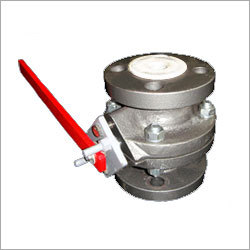
About PTFE Lined Ball Valve
PTFE Lined Ball Valve
| Size | DN 25 | DN 40 | DN 50 | DN 80 | DN 100 |
| F mm | 48 | 69 | 88 | 118 | 151 |
| H max mm | 125 | 150 | 160 | 195 | 215 |
| L max mm | 127 | 165 | 178 | 203 | 229 |
Lining Material : PTFE / PP (Poly Propyline) / HDPE
Test
- Hydro Test At 10 Kg/cm2
- Spark Test At 10 Kv
- Air Leak Test 3 Kg/cm2
Unmatched Chemical ResistanceThe PTFE Lined Ball Valve is specifically designed for environments where handling corrosive fluids is critical. Its PTFE lining completely isolates the fluid from the valve body and ball, ensuring long-lasting protection against acids and chemicals. This results in reduced maintenance and extended operational life, even under harsh process conditions.
Versatile Applications Across IndustriesEngineered for compatibility with ANSI, DIN, or JIS flanges, this valve meets the demands of chemical processing, pharmaceuticals, water treatment, and petrochemical industries. Its ability to support full-bore flow with port sizes from 15mm to 300mm makes it suitable for a wide range of pipelines and process requirements.
Reliable and Easy OperationWith a manual actuation mechanism and durable two- or three-piece body design, the PTFE Lined Ball Valve offers straightforward operation and maintenance. The superior sealing provided by the PTFE lining minimizes leakage risks, enhancing safety and process integrity in critical applications.
FAQs of PTFE Lined Ball Valve:
Q: How does a PTFE lined ball valve improve performance with corrosive fluids?
A: The PTFE lining isolates the fluid from both the valve body and the stainless steel ball, offering high resistance to acids, chemicals, and corrosive agents. This prevents contamination and corrosion, significantly increasing the valves operational lifespan in aggressive environments.
Q: What industries benefit most from PTFE lined ball valves?
A: Industries such as chemical processing, pharmaceuticals, water treatment, and petrochemicals gain substantial benefits due to the valves resistance to harsh chemicals and its compliance with stringent process standards.
Q: When is it appropriate to use a full bore PTFE lined ball valve?
A: A full bore PTFE lined ball valve should be used when minimal pressure drop and unrestricted flow are required, particularly in processes involving viscous, abrasive, or corrosive media.
Q: Where can the PTFE lined ball valves be installed?
A: These valves are designed for pipelines requiring flanged connections built to ANSI, DIN, or JIS standards, making them suitable for various global installation sites and retrofitting into existing systems.
Q: What is the process for maintaining a PTFE lined ball valve?
A: Maintenance is simplified due to the two- or three-piece body construction. Routine inspection should focus on checking the integrity of the PTFE lining and seals. If needed, the valve can be disassembled for cleaning or part replacement without removing it entirely from the pipeline.
Q: How do suppliers in India ensure valve quality and international compatibility?
A: Reputable manufacturers in India adhere to international flange standards (ANSI/DIN/JIS) and pressure ratings (Class 150/PN16), performing rigorous quality control throughout production to meet the needs of exporters and global end-users.
Q: What advantages does manual operation offer for PTFE lined ball valves?
A: Manual operation provides precise control over flow and immediate feedback to operators, making it ideal in settings where automation is unnecessary or where manual oversight is critical for process safety.





 Send Inquiry


 Send Inquiry
 Send Inquiry
 Send SMS