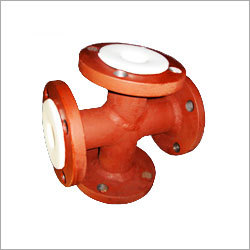
About PTFE Lined Equal Cross
PTFE Lined Equal Cross
Dimensional Data
| Size | DN 25 | DN 40 | DN 50 | DN 65 | DN 80 | DN 100 | DN 150 | DN 200 | DN 250 | DN 300 |
| F mm | 48 | 69 | 88 | 105 | 118 | 151 | 205 | 256 | 312 | 363 |
| A mm | 90 | 102 | 115 | 127 | 140 | 165 | 203 | 229 | 279 | 305 |
| Liner thick mm | 3.5 | 4 | 4.2 | 4.5 | 5 | 5 | 6.5 | 7 | 7.2 | 7.5 |
Lining Material : PTFE / PP (Poly Propyline) / HDPE
Test
- Hydro Test At 10 Kg/cm2
- Spark Test At 10 Kv
- Air Leak Test 3 Kg/cm2
Exceptional Corrosion ResistanceThe combination of carbon steel and high-purity PTFE lining in this equal cross ensures superior resistance to harsh chemicals, making it highly suitable for corrosive fluid transport. The lining thickness of 35 mm provides robust protection, supporting smooth operations and extended service life even in aggressive working conditions.
Reliable Performance & SafetyManufactured to meet stringent ASTM, DIN, and BS standards, our PTFE lined cross maintains dimensional precision (1 mm tolerance) and pressure integrity (up to 10 bar). Epoxy coating and full face flange design further enhance durability and operational safety in chemical processes.
FAQs of PTFE Lined Equal Cross:
Q: How is the PTFE lining applied to the carbon steel body in the equal cross?
A: The PTFE lining is securely bonded to the carbon steel body via a mechanical locking or molding process. This ensures complete coverage and prevents any direct contact between the conveyed media and the steel, thus offering long-lasting chemical resistance and mechanical stability.
Q: What are the primary benefits of using a PTFE lined equal cross in fluid handling systems?
A: The main benefits include superior corrosion and abrasion resistance, long service life, and validation for use with highly corrosive or pure chemicals. The PTFE lining prevents product contamination, while the carbon steel shell supplies structural strength, making it an ideal choice for harsh processing environments.
Q: When should a PTFE lined cross be selected over other corrosion-resistant materials?
A: A PTFE lined cross is recommended when transporting aggressive, corrosive, or ultra-pure chemicals that would degrade or contaminate standard metallic components. Its particularly advantageous in applications where both high chemical compatibility and mechanical integrity are required, such as in the pharmaceutical or chemical industries.
Q: Where is this PTFE lined cross typically used?
A: This fitting is suitable for use in chemical plants, pharmaceutical manufacturing facilities, and any operations handling corrosive, hazardous, or reactive fluids. It is also commonly installed in process piping systems demanding high cleanliness and reliability.
Q: What process standards does the PTFE lined equal cross comply with?
A: It adheres to ASTM F1545, DIN 2848, and BS 5351 for design and manufacturing, with flange thickness conforming to ASME B16.5. These ensure global interchangeability, dimensional accuracy, and robust performance in critical installations.
Q: How does the full face flanged connection enhance installation flexibility?
A: The full face flanged connection allows for quick, secure installation and reliable sealing with standard gaskets. It accommodates various flange standards to ensure compatibility with existing piping layouts and simplifies maintenance or component replacement.
Q: What advantages does the epoxy coating provide?
A: The external epoxy coating on the carbon steel body increases resistance to external corrosion and environmental wear, ensuring the longevity of the component, especially in aggressive industrial atmospheres.





 Send Inquiry


 Send Inquiry
 Send Inquiry
 Send SMS