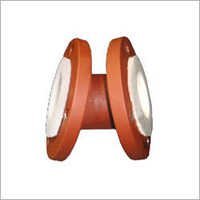
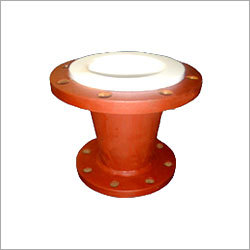
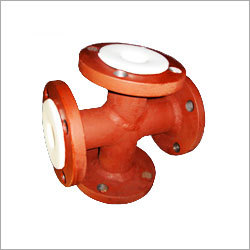
About PTFE Lined Pipe Fittings
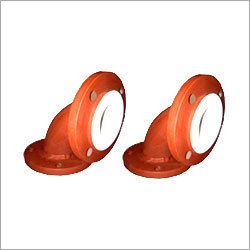
PTFE Lined Elbow 90
Dimensional Data
Size | DN 25 | DN 40 | DN 50 | DN 65 | DN 80 | DN 100 | DN 150 | DN 200 | DN 250 | DN 300 |
| F mm | 48 | 69 | 88 | 105 | 118 | 151 | 205 | 256 | 312 | 363 |
| A mm | 90 | 102 | 115 | 127 | 140 | 165 | 203 | 229 | 279 | 305 |
| Liner thick mm | 3.5 | 4 | 4.2 | 4.5 | 5 | 5 | 6.5 | 7 | 7.2 | 7.5 |
Lining Material: PTFE / PP (Poly Propyline) / HDPE
Test: - Hydro Test At 10 Kg/cm2
- Spark Test At 10 Kv
- Air Leak Test 3 Kg/cm2
Engineered for Chemical ResistanceThe PTFE lining within each fitting provides an inert, non-reactive interior surface, ensuring safe transport of aggressive chemicals and acids. This minimizes the risk of corrosion, contamination, and maintenance downtime, making these fittings ideal for demanding applications.
Precision and ComplianceManufactured to strict standards such as ASTM F1545, DIN 2848, and ASME B16.5, these fittings maintain critical dimensions and mechanical properties. Tolerance levels are maintained at 1 mm, ensuring consistent fit and performance during installation and operation.
Versatile ApplicationsThese PTFE lined fittings are widely used in industries requiring leak-proof, chemical-resistant piping solutions. Applications include chemical processing, acid handling, water treatment systems, and pharmaceutical manufacturing, meeting regulatory and operational needs with reliable performance.
FAQs of PTFE Lined Pipe Fittings:
Q: How are PTFE lined pipe fittings used in industrial applications?
A: PTFE lined pipe fittings are employed to transport corrosive or reactive fluids in industries such as chemical processing, pharmaceuticals, food manufacturing, and water treatment. The inert PTFE lining provides superior chemical resistance, protecting the underlying carbon steel and ensuring long service life.
Q: What is the manufacturing process for these PTFE lined fittings?
A: The fittings are manufactured by fabricating the carbon steel body (as per IS 2062 or ASTM A106 Gr.B), followed by precision lining of the interior with virgin PTFE. The lining is securely bonded and checked for uniformity, and the fittings undergo final coating with fusion bond epoxy or paint for external protection.
Q: When should PTFE lined fittings be chosen over other material fittings?
A: PTFE lined fittings are ideal when transporting highly corrosive or sensitive chemicals that can degrade metal surfaces or where metal contamination must be avoided. Their excellent chemical resistance and sealing performance are preferred in environments where process purity and safety are critical.
Q: Where can these PTFE lined fittings be installed?
A: These fittings are suitable for installation in chemical plants, pharmaceutical manufacturing facilities, water treatment plants, and food processing lines. They are adaptable to any setting requiring robust, corrosion-resistant, and leak-proof fluid transport system.
Q: What are the main benefits of using PTFE lined pipe fittings?
A: The primary benefits include outstanding corrosion resistance, extended operational life, minimal maintenance, and compliance with international standards. The PTFE lining ensures fluid purity and mechanical strength, while flanged ends provide reliable, leak-proof connections.
Q: How is sealing achieved in these fittings?
A: Sealing is accomplished using PTFE gasket material at the flanged connections, ensuring a tight, leak-free joint capable of handling rated pressures ranging from PN10 to PN25 or 150lb to 300lb, depending on application requirements.





 Send Inquiry


 Send Inquiry
 Send Inquiry
 Send SMS
 Call Me Free